
News
Asturias is dreaming of a future for food that is based on respect for the land
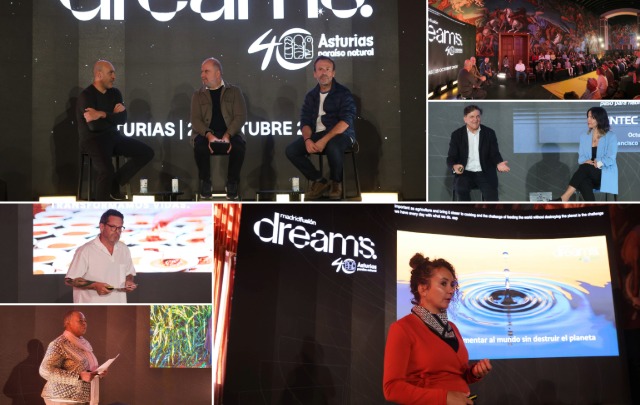
La Laboral Ciudad de la Cultura (Gijón/Xixón) becomes the epicentre of a dialogue between chefs, producers, agricultural entrepreneurs, and activists. Together, they are creating a new global gastronomic narrative based on respect for the land and tradition.
Madrid Fusión Dreams Asturias explores how gastronomy can regenerate landscapes, empower communities, and transform the way we feed the world.
For one day, Gijón/Xixón set the pace for the future of food. At La Laboral Ciudad de la Cultura, Dreams Asturias — the travelling edition of the Madrid Fusión Dreams congress — brought together chefs, scientists, farmers, historians and activists to consider how we eat, how we grow food, and our dreams for the future of food. Technology and memory, science and the land, cuisine and consciousness came together to reflect, diagnose and build a shared narrative: that of a gastronomy which heals, connects and transforms society.
"Dreams taste different when they are cooked in Asturias," proclaimed Gimena Llamedo, Vice-President of the Principality of Asturias, host of the congress and opening speaker. She recalled that this land practises sustainability from the ground up, saying: 'In Asturias, sustainability is not just talk; it is a way of life.' She also highlighted the role of women — cooks, scientists, activists and producers — who feed people fairly and equitably through their work.
Benjamín Lana, the director of Madrid Fusión, described Dreams as 'the umami of words', defining it as a conference where cooking is replaced by dialogue, confrontation and reflection on the transformative power of gastronomy. “Here,” he said, “we combine science and conscience. We look to the past to secure the future. We discuss the countryside, tourism, food sovereignty, and the demographic challenge. Gastronomy is not frivolous; it is memory, culture, and a connection to nature.”
Memory as an ingredient?
The first conversation, 'Retrogastronomy: eating with memory', brought together two leading figures in rural cuisine: Luis Alberto Lera of Restaurante Lera** (Castroverde de Campos, Zamora), and Nacho Manzano of Casa Marcial**** (La Salgar, Parres, Asturias).
Lera championed cuisine rooted in the landscape as a driver of repopulation and local pride: ‘I cook the territory. Where others see empty fields, I see life. My restaurant has brought movement and meaning back to a village of 200 inhabitants that now welcomes 17,000 diners a year.” He also championed the value of legumes and ancient flavours that are in danger of extinction, stating that lentils are a surprise inclusion on his tasting menu because their importance has been forgotten.
Nacho Manzano recalled his humble origins and his apprenticeship among family fires: ‘I had no training; I had an education. Cooking is memory, landscape and respect.’ He emphasised the importance of the elderly as guardians of flavour and expressed concern about rural depopulation, stating that young people who open a chigre in a village should be given the red carpet treatment. His final statement was emphatic: ‘Excellence is non-negotiable.’
Traditional cuisine was also debated at a roundtable discussion featuring three interesting perspectives: Charo Carmona (Arte de Cozina, Antequera), Rosa Tovar (culinary historian) and María Busta (Casa Eutimio, Lastres/Llastres). Carmona defended traditional cuisine as an act of resistance and transmission. “Cooking has soul. We must cook with children so that this tradition is not lost." Tovar recalled that tradition is what remains of what has been done well. ‘Ferran Adrià is already a tradition.’ Busta, a skilled chef, championed the value of hard work and the significance of the Asturian pot as a symbol of survival, saying, "Understanding our past is essential for navigating our future."
From the soil to the moon: science, tradition and sovereignty
Núria Madeo (The Regen Academy) explained that caring for the soil means caring for human health. “Soil microorganisms are similar to those in our bodies. If the earth dies, so do we.” She proposed regenerative agriculture without chemicals, which retains carbon, captures water, and increases biodiversity. This is a model that restores the earth's natural and economic power.
Elizabeth Mpofu, a farmer and peasant leader who founded the Zimbabwe Small-Scale Organic Farmers Forum, provided the international focus. She sent a clear message: ‘The future of food lies not in laboratories, but in rural communities.’ She advocated the creation of a community of farmers, chefs and scientists to transform food systems, and urged governments to recognise food sovereignty and promote fair trade and transparent supply chains. She also emphasised the vital role of women in African agriculture. "When women rise, the soil heals," she concluded.
Vicent Guimerà (L'Antic Molí**, Ulldecona, Tarragona) and João Rodrigues (Canalha, Lisbon) demonstrated how cooking can regenerate landscapes and restore ecosystems. They presented their respective comprehensive projects, Mans and Materia. These projects focus on cooking in a specific region and highlight the people who supply the chefs with produce.
In João's case, Materia has mapped Portuguese producers, facilitating alliances that reduce transport costs. Additionally, through his restaurant, Canalha, he combats the gentrification of cities like Lisbon. Vicent acquires land in the Delta to supply his restaurant's pantry, practising regenerative agriculture that connects producers with his business.
Innovating without forgetting
The final session opened the debate on feeding the world without destroying the planet. Mercedes Iborra (VisualNAcert) spoke about the role of technology in rural areas and the potential of superfoods: 'They take care of the earth and they take care of us. But the soil needs knowledge, science and respect." Elena Burillo, the young Aragonese agro-influencer, addressed generational change and rural pride, saying: 'Success is not about leaving the village. It's about staying and building a future there.' The countryside and the kitchen must walk hand in hand.'
Zineb Hattab, a Spanish-Moroccan chef based in Switzerland and head of the KLE** restaurant in Zurich, shared her vision of vegetable-based cuisine with roots and awareness. This is the result of her personal evolution from traditional cuisine containing animal products to a plant-based approach without sacrificing pleasure or emotion. She defines herself as a citizen of the world who cooks with passion and respect for the environment, while honouring the past. She believes that looking to the past — to grandmothers and their abundant fruit bowls, and to the natural way in which they ate vegetables — is essential for caring for both the product and the planet. Her motto, “Think about what I have, not what I lack,” sums up her philosophy: a vegetable-based cuisine that transcends labels and has allowed her to reconnect with her identity.
David Hertz (Gastromotiva.org) from Brazil gave an exciting and sensitive presentation in which he defended social cuisine as a tool for change: “Our ingredients are people. We cook to generate dialogue.” His work with young people from disadvantaged or conflict-ridden communities in Brazil and Mexico demonstrates that gastronomy has the power to elevate professions, provide alternatives and transform lives.
The closing of this Dreams session looked to the universe quite literally: Juan Francisco Delgado (Vice-President of the European Foundation for Innovation) and Macarena Rodríguez Walker (Daff Foods, Chile) presented projects involving the cultivation of crops on lunar soil and technologies for feeding people in extreme conditions, which could be used both in space and on Earth.
‘The Moon is not the destination,’ they said. ‘It is a rehearsal for how we should take care of our own planet.’ Madrid Fusión Dreams Asturias was much more than a gastronomic conference. It was a collective conversation in which memory, science, technology and the earth were brought together to envisage a better, fairer and more supportive future.
It was an event where Asturias reaffirmed itself as a gastronomic territory with global ambition, soul, and identity. As the Vice-President of the Principality of Asturias, Gimena Llamedo, reminded us, 'the future is cooked slowly, with roots, dreams and respect for the earth'.